When you come home from the hospital or birth center, it is easy to feel a quiet pressure to bounce back, check off a recovery to-do list, or start working on your core right away. As a pelvic health physical therapist and a mother of two, I want to give you permission to put all of that down. The early stages of postpartum recovery are about healing and adjusting to life with your newborn.
The American College of Obstetricians and Gynecologists calls these weeks after delivery the "fourth trimester," recognizing it as a time of major physical and emotional recovery [1]. They recommend having contact with your maternal care provider within the first 3 weeks after birth, followed by ongoing support and a full visit no later than 12 weeks postpartum to check on your sleep, fatigue, and physical healing [1]. Right now, resting on the couch with your baby on your chest is productive work, and your workouts will still be waiting for you when your body is ready!
Why is the first poop after birth so intimidating?
Let's talk openly about the thing almost every new mom dreads: the first poop after birth. You have just gone through a huge physical event. Everything down there feels tender or swollen, you might be dealing with stitches from a tear or an episiotomy, or your abdomen feels sore and guarded after a C-section. It is completely understandable if you sit on the toilet and feel afraid to let go.
On top of that normal fear, postpartum constipation is incredibly common in the early days. Hemorrhoids, soreness at a tear or incision, shifting pregnancy hormones, and iron supplements can all slow your bowels down [3]. In a study of pregnant and postpartum women in Finland, 52% of women had constipation just a few days after delivery, compared with 21% of non-pregnant women of the same age [2].
If your bowels are moving slowly right now, you are in very good company. Even better, that same study found that by one month after birth, constipation dropped to 9% after a vaginal delivery and 15% after a cesarean, returning to the level of non-pregnant women or better [2]. Your body is simply recalibrating after delivery, and with a few kind adjustments, you can make those early trips to the bathroom much easier on yourself.
How do you poop in early postpartum recovery without straining?
When patients ask me how to poop after birth without hurting themselves, I share five simple habits that take the pressure off your healing tissues. We talk a lot in my clinic about why bowel health matters so much for your pelvic floor, especially when everything is fresh and healing.
Prop your feet up on a footstool. Bringing your knees up above your hips can make it easier to relax and let go. In a 4-week study of healthy adult volunteers, people using a toilet footstool reported straining less and emptying their bowels more fully [4]. To be completely honest with you, the volunteers were not postpartum, the results were self-reported, and the maker of the footstool supplied the devices for the study, so treat this as a simple, low-risk tip rather than a proven medical treatment [4]. Even a couple of sturdy shoeboxes under your feet can help you feel much more comfortable on the toilet.
Use your breath instead of holding it. When we are nervous or backed up, our instinct is to hold our breath and bear down hard. That pushes straight down on a tender pelvic floor or a healing incision. Instead, take a slow inhale, let your belly soften, and breathe out gently through your mouth as if you are blowing out birthday candles while your body does the work.
Use perineal or belly support as needed. Sometimes your healing tissues just want a little counter-pressure so they do not feel like they are stretching too much. If you had a vaginal birth, you can fold up clean toilet paper or a clean pad and hold it gently against your perineum while you go. If you had a cesarean birth, holding a small pillow gently against your lower belly gives your incision that same comforting support.
Stay ahead on hydration. Your body is shedding extra fluid from pregnancy, healing tissues, and often making milk. Keep a large water bottle wherever you sit to feed the baby, because soft stool requires plenty of fluids.
Ask your provider about stool softeners. A large review of the research found too little good evidence to say how well laxatives work, or how safe they are, for preventing constipation after birth [3]. Because every recovery is different, talk with your doctor or midwife about whether a stool softener is a smart choice for you.
Most of the time, these gentle strategies get things moving comfortably. Please consult a healthcare provider if your bowels still have not moved and you feel uncomfortable or worried, or if you notice severe belly or rectal pain, blood in your stool, a fever, heavy vaginal bleeding, or pain that gets worse instead of better. Calling your doctor or midwife early is always the right move when something feels off.
What can you do for postpartum upper back pain and "mom back"?
While your pelvis is resting, your upper body is suddenly working overtime. Between feeding, burping, rocking, and staring down at this tiny human you made, you end up in the ultimate rounded-shoulder posture for hours a day. In my practice, I call this "mom back," and that thoracic spine stiffness can creep up on you fast during the first two weeks.
Research backs up what your aching shoulders are telling you. In a survey of 395 breastfeeding mothers between 1 and 48 months postpartum, 84% experienced back pain at least once a month, especially mothers who spent more time on each feed and more total hours feeding each day [5]. Interestingly, the mothers who preferred to feed lying down had less intense neck pain than those who fed sitting in a chair or armchair, leading the researchers to suggest lying or semi-lying positions with your head well supported [5].
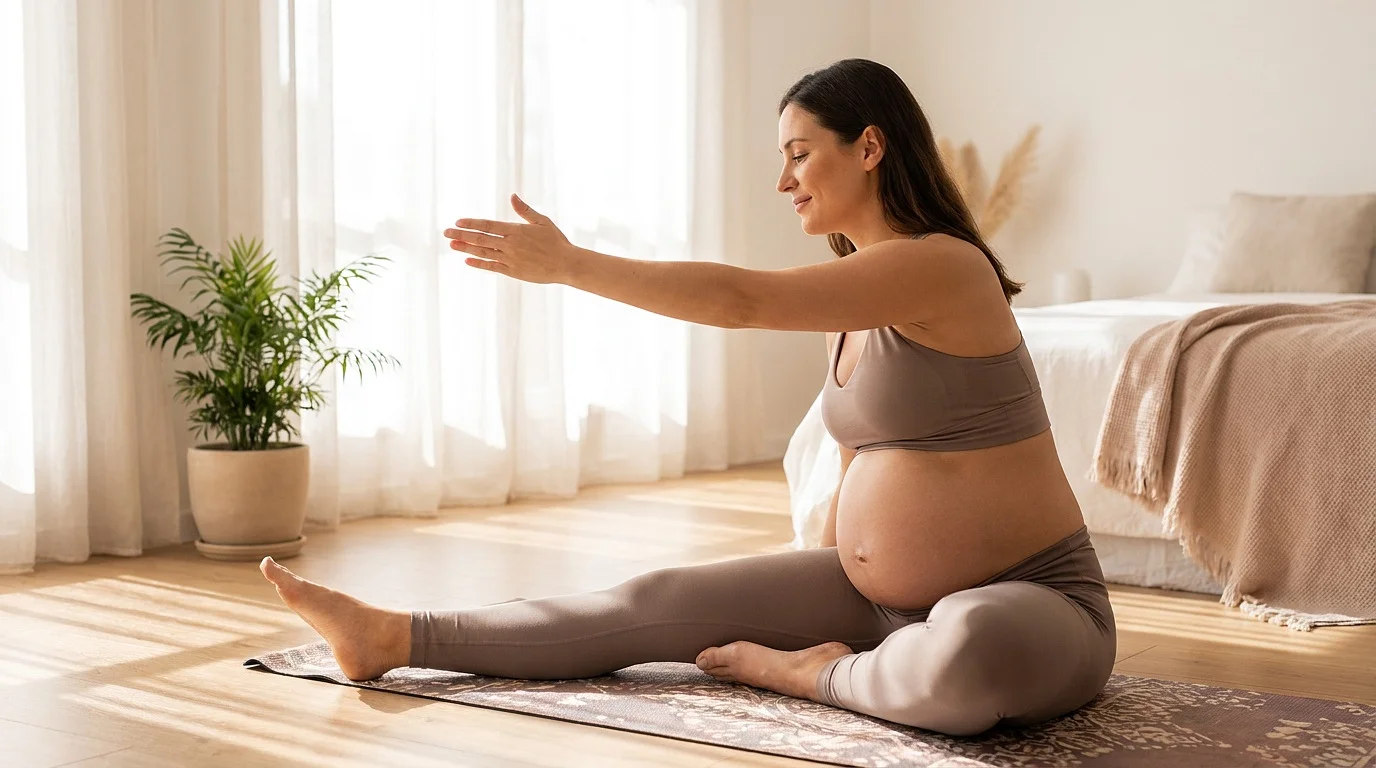
Beyond propping yourself up with extra pillows during feeds, you can sprinkle in a few gentle upper-body movements right from the edge of your bed or couch. None of these should hurt, and there is no breath-holding allowed.
Yoga breaths with arms overhead: Sit or stand comfortably. As you take a slow, deep inhale into your ribs, sweep both arms out to the sides and up overhead. As you exhale slowly, float your arms back down. This opens up a tight chest and reminds your ribcage how to expand after months of pregnancy.
Bow and Arrow movements: You can do this seated or lying on your side. Reach both arms straight out in front of you with your palms together. Slowly draw one elbow back as if you are pulling a bowstring, letting your upper back rotate and following your moving hand with your eyes, then glide it back to the front. Switch sides after a few slow reps.
"No Monies" with head tilts: Bend your elbows to 90 degrees and tuck them comfortably against your sides with your palms facing up, as if you are holding two trays. Keeping your elbows gently near your ribs, turn your hands outward so your shoulder blades glide toward each other. Hold that gentle opening for a breath while you slowly tilt your ear toward one shoulder and then the other to release neck tension.
Is walking okay in the first two weeks after birth?
Along with those upper-body stretches, I do recommend walking in early recovery if your body feels up for it. A short, slow stroll down the driveway or around the block can lift your mood and help get things moving.
According to guidelines from the American College of Obstetricians and Gynecologists, physical activity can resume gradually after pregnancy as soon as it is medically safe, depending on whether you had a vaginal or cesarean birth and whether you had any medical or surgical complications [6]. If you had a C-section or a complicated delivery, check in with your doctor or midwife first, and let your body set the pace so that a walk leaves you feeling refreshed rather than wiped out.
Where does postpartum pelvic floor physical therapy fit in?
As you settle into life with your baby, you might start wondering what comes next for your core and pelvic floor, whether that is checking for diastasis recti after baby, learning about C-section scar massage, or figuring out when you can return to running. If you are curious about what a visit looks like, you can read my guide on what to expect from postpartum physical therapy or my overview of pelvic floor physical therapy. If you already have questions on your mind, you can book a free 15-minute discovery call with me anytime to talk through what you are feeling.
Here are the three questions new moms ask me most often about getting started:
How soon can you start pelvic floor PT after birth?
When you can start depends on how your birth went and what your obstetric provider recommends. An early visit is all about gentle education, breathing mechanics, posture for feeding, and comfort strategies, while any internal pelvic floor assessment waits until your tissues have healed and your provider gives you medical clearance.
Should everyone do pelvic floor therapy after birth?
You do not have to go to physical therapy just because you had a baby, though in my view, every new mother can benefit from having someone check how her pelvic floor and core are coordinating after pregnancy. Even one visit where someone listens to your birth story and checks whether your muscles are relaxing and contracting well can give you huge peace of mind as you return to the activities you love.
When to see a physical therapist postpartum?
Rather than watching the calendar, pay attention to the signs your body is giving you. It is time to see a pelvic health physical therapist if something does not feel right: leaking urine or stool, bladder urgency, heaviness or bulging in your vagina, ongoing constipation or straining, tailbone pain, a C-section scar that feels tight or painful, or pain when you return to sex. Common does not mean you just have to live with it!
Whether you are two weeks postpartum and trying to get comfortable in your body, or months down the road and realizing something still feels off, you do not have to figure it out alone. At Protea Physical Therapy & Wellness in Anaheim Hills, I help mothers across Orange County recover at a pace that respects real life with a baby. Whenever you are ready to talk, call (909) 265-3584 or book a free 15-minute discovery call, and I will help you set up a game plan that feels right for you.
Disclaimer: This article is for general educational information only. It is not medical advice or a diagnosis, and it does not replace an individualized examination with a qualified healthcare provider.
Sources
American College of Obstetricians and Gynecologists. ACOG Committee Opinion No. 736: Optimizing Postpartum Care. Obstetrics & Gynecology, 2018 (reaffirmed 2021). https://pubmed.ncbi.nlm.nih.gov/29683911/
Kuronen M, Hantunen S, Alanne L, et al. Pregnancy, puerperium and perinatal constipation: an observational hybrid survey on pregnant and postpartum women and their age-matched non-pregnant controls. BJOG, 2021;128(6):1057-1064. https://pubmed.ncbi.nlm.nih.gov/33030260/
Turawa EB, Musekiwa A, Rohwer AC. Interventions for preventing postpartum constipation. Cochrane Database of Systematic Reviews, 2020. https://pubmed.ncbi.nlm.nih.gov/32761813/
Modi RM, Hinton A, Pinkhas D, et al. Implementation of a defecation posture modification device: impact on bowel movement patterns in healthy subjects. Journal of Clinical Gastroenterology, 2019;53(3):216-219. https://pubmed.ncbi.nlm.nih.gov/30346317/
Ratajczak M, Gornowicz R. The influence of breastfeeding factors on the prevalence of back and neck pain: data from an online survey. BMC Musculoskeletal Disorders, 2024;25(1):675. https://pubmed.ncbi.nlm.nih.gov/39210354/
American College of Obstetricians and Gynecologists. ACOG Committee Opinion No. 804: Physical Activity and Exercise During Pregnancy and the Postpartum Period. Obstetrics & Gynecology, 2020;135(4):e178-e188. https://pubmed.ncbi.nlm.nih.gov/32217980/