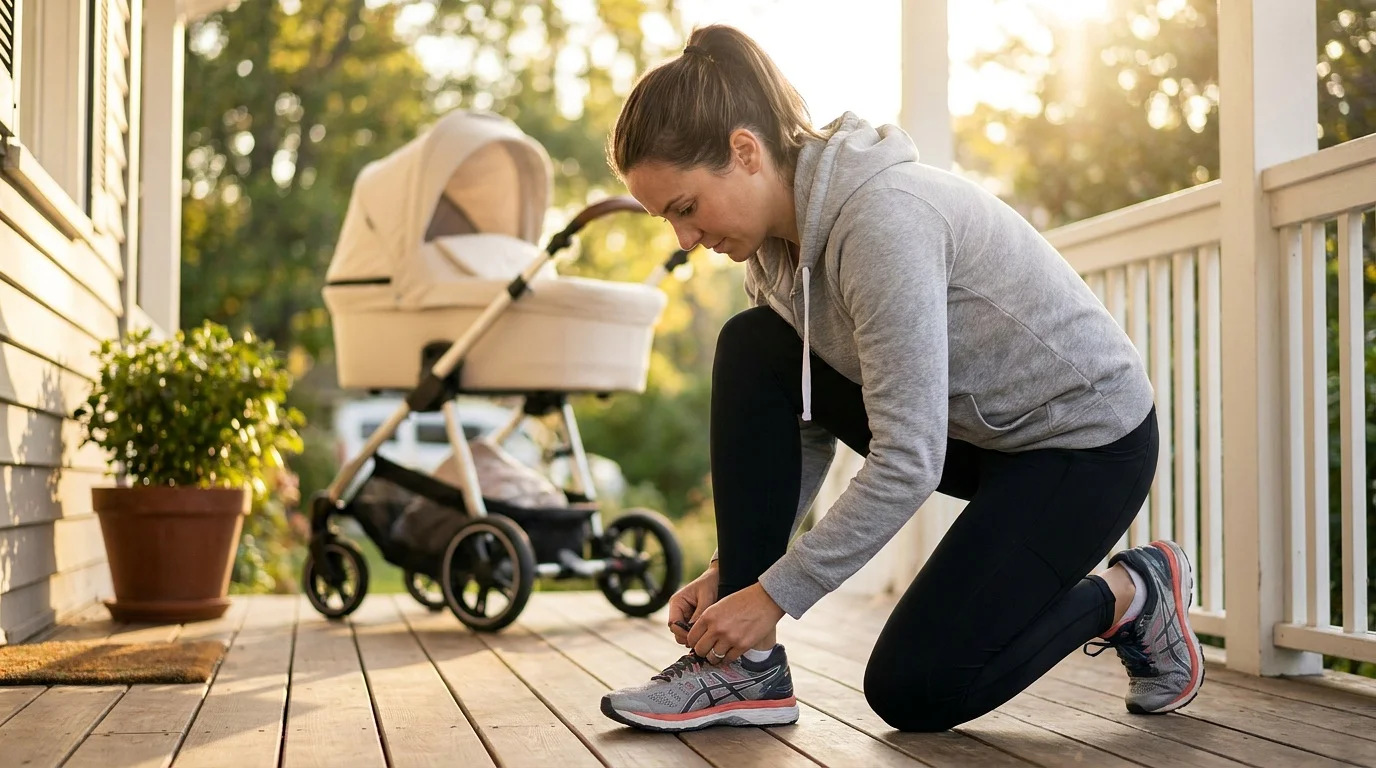
If you were a runner before baby, there's a specific kind of ache that has nothing to do with your hips. It's the itch to lace up and head out the door the way you used to. Maybe your doctor cleared you at your six-week visit and said you were good to go, but something still feels a little off, and you're quietly wondering whether it's actually safe. I get this question all the time in my Anaheim Hills practice, so let's talk honestly about returning to running postpartum: when, how, and how to know your body is truly ready.
So when can I actually start running again after baby?
Here's the short version: for most new moms, running is closer to a twelve-week milestone than a six-week one. Your six-week clearance is the start of the conversation, not the finish line.
The widely used 2019 return-to-running guidelines from a team of pelvic health physiotherapists suggest that around three months postpartum is the earliest sensible window for most people, and even then, only once your body can handle impact comfortably. The American College of Obstetricians and Gynecologists (ACOG) takes a similar tone: ease back into activity gradually once you're medically cleared, and if you had a C-section, give yourself extra runway before you add impact. Notice the theme. It's less about the date on the calendar and more about what your body can actually tolerate.
Why isn't my six-week clearance the green light to run?
This is the part almost nobody explains. Your six-week check confirms that the big things have healed: the bleeding has settled, any incision is closing, your tissues are recovering. What it doesn't check is whether your pelvic floor and deep core can absorb the load of running, which asks those muscles to manage two to three times your bodyweight with every single stride.
That's a big job for a system that spent nine months stretching and supporting a baby. Pelvic floor dysfunction shows up in more than one in four women, so if things feel different down there, you are in very good company. If you want the bigger picture on how recovery actually works, I walked through it in what to expect from postpartum physical therapy.
How do I know if my body's ready?
Good news: there's a simple way to gut-check this before you ever hit the pavement. I look for a handful of signs that your system can handle load:
You can walk briskly for 30 minutes with no pain or symptoms
You can balance on one leg steadily
You can perform some very gentle impact activities, like mini jumps, without sensations of heaviness or leaking, and being able to breathe well
In my practice, I screen at minimum these activities. If a drill brings on symptoms, that's not a failure. It's just useful information about where to start.
What if I leak or feel heavy when I run?
First, please know this is common, and please know it's not something you have to push through. More than a third of postpartum runners notice leaking or pain when they return to running, so if a few drops sneak out on your first jog, you're not broken and you're not alone.
That leaking, or a feeling of heaviness or dragging, is your pelvic floor waving a little flag that says it needs more support before this much load. The answer usually isn't to stop forever or to white-knuckle through it. It's to back off, build the right strength, and load more gradually. Leaking is honestly one of the most treatable things I work with, and I dig into it more in what incontinence treatment actually looks like.
How do I ease back into running postpartum without setting myself back?
When you're ready, slow and steady genuinely wins here. A progression I like looks something like this:
Rebuild your foundation first: deep core and pelvic floor coordination, not just kegels
Walk, and build up to comfortable, brisk 30-minute walks
Build up single leg strength and balance
Add low-impact work like the elliptical or walk-jog intervals
Move into a graded run-walk, something like one minute jogging, two minutes walking, repeated
Gradually stretch the running intervals until you're back to continuous running
If you're also dealing with an abdominal gap, impact can aggravate it, so it's worth checking your diastasis recti before you ramp up. ACOG suggests aiming for around 150 minutes of activity a week, and you can absolutely build toward that with this kind of gradual on-ramp. The golden rule through all of it: if pain or leaking shows up, that's your cue to ease back, not to power on.
A few other quick tips:
It's worth it to double-check the fit of your running shoes. Feet can change a lot during pregnancy - especially if you've had more than one! A good fit can make return to running easier.
Double check the fit of your bra. This one can be a little challenging, but the breasts change size and shape, and a poorly fitted bra can impact your breathing, your posture, and how your body accepts impact.
And finally, if you're producing milk, it's best to try your return to running soon after a pumping or feeding time to increase your comfort level.
Do I really need a pelvic floor PT, or can I just follow a plan?
You can find plenty of generic return-to-running plans online, and honestly, some of them are pretty good. The catch is that they can't feel your body. A one-on-one assessment runs that readiness screen on you specifically, finds the actual weak link, whether it's your pelvic floor, your deep core, or even a tender C-section scar, and builds your progression around it. In my Anaheim Hills practice, every visit is one-on-one and most runners start feeling real changes within a few visits.
Take this with you
You're not broken, you're rebuilding, and rebuilding is supposed to take a little time. The goal was never to run at six weeks. It's to run strong and symptom-free for decades. If you're in Anaheim Hills or anywhere in Orange County and you want a real plan for getting back out there, I'd love to help. Call or text me at (909) 265-3584, or book a session online whenever you're ready.
Frequently asked questions
Can I run at six weeks postpartum if I feel fine?
Feeling fine is a wonderful sign, but it doesn't always mean your pelvic floor is ready for impact. Most experts suggest waiting closer to twelve weeks and passing a simple load test first, even when you feel great.
Is it normal to leak a little when I run after having a baby?
It's common, but it's not something you have to live with. Leaking is your pelvic floor asking for more support, and it responds really well to the right strengthening and a smarter loading plan.
How long before I can run again after a C-section?
A C-section is major abdominal surgery, so you'll usually want a bit more runway. Build up gradually after your six-week check, and have your core and scar assessed before you add running.
Can running too soon cause prolapse?
Going back to high impact before your system is ready can contribute to symptoms like heaviness or a bulging sensation. That's exactly why the gradual, screen-it-first approach matters so much.
References
American College of Obstetricians and Gynecologists. Physical Activity and Exercise During Pregnancy and the Postpartum Period. ACOG Committee Opinion No. 804. Obstetrics & Gynecology. 2020;135(4):e178-e188. https://www.acog.org/clinical/clinical-guidance/committee-opinion/articles/2020/04/physical-activity-and-exercise-during-pregnancy-and-the-postpartum-period
Goom T, Donnelly G, Brockwell E. Returning to Running Postnatal: Guidelines for Medical, Health and Fitness Professionals Managing This Population. 2019. https://www.researchgate.net/publication/335928424_Returning_to_running_postnatal_-_guidelines_for_medical_health_and_fitness_professionals_managing_this_population
Selman R, Early K, Battles B, Seidenburg M, Wendel E, Westerlund S. Maximizing Recovery in the Postpartum Period: A Timeline for Rehabilitation from Pregnancy Through Return to Sport. International Journal of Sports Physical Therapy. 2022;17(6):1170-1183. https://pmc.ncbi.nlm.nih.gov/articles/PMC9528725/
This article is for general education and isn't a substitute for personalized medical advice. Always check with your own healthcare provider about your specific situation.