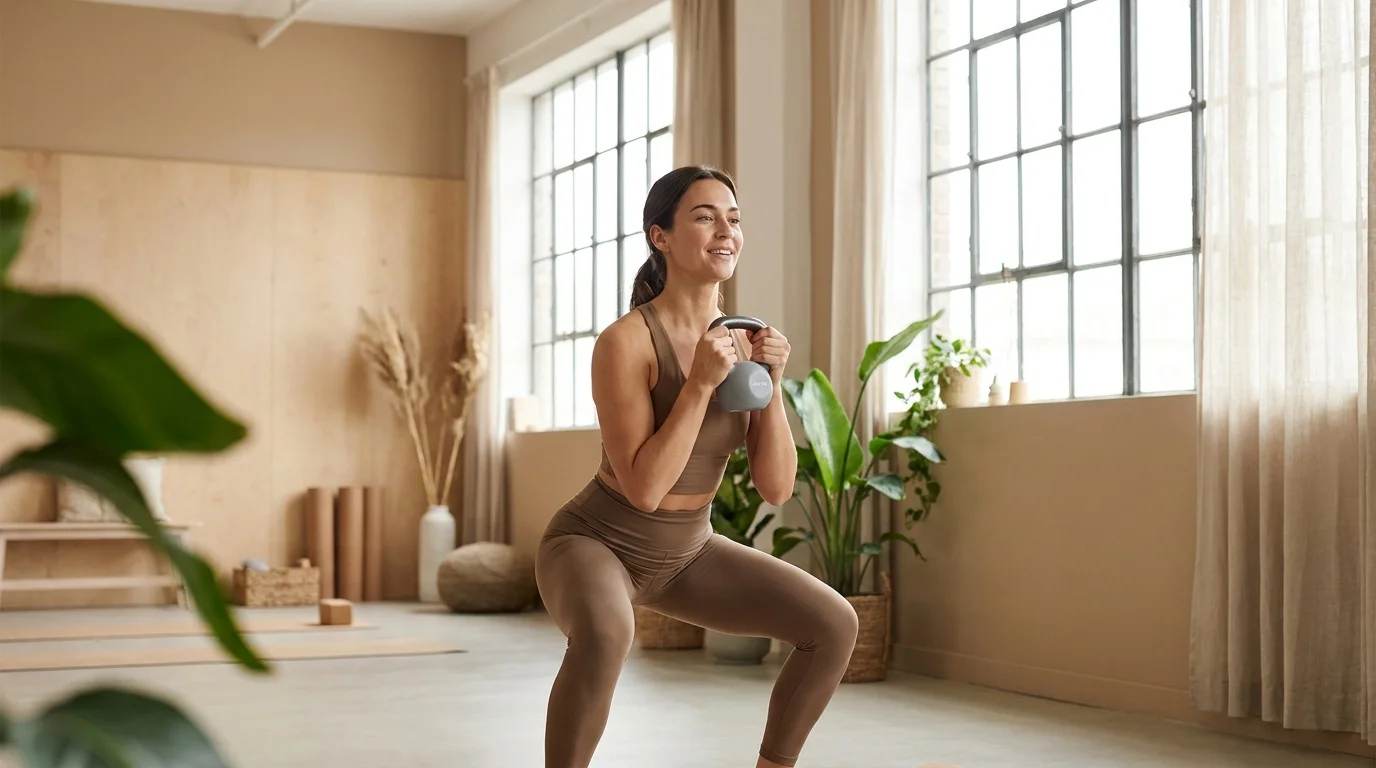
Yes, you can usually keep exercising and lifting weights with a tight or overactive pelvic floor, and in my practice I typically encourage it. The goal is to change how you breathe, recover, and share the load with your glutes, legs, and core, so your pelvic floor can finally relax while you keep doing the workouts you love.
When someone tells you that your pelvic floor is too tight, your first instinct might be to cancel your gym membership and stay far away from a barbell. It can sound counter-intuitive to work out, especially to lift weights, when you already know you are holding a lot of tension down there. If your muscles are clenched, wouldn't lifting heavy things just make them clench harder?
I hear this worry all the time in my practice, and I completely understand why you feel hesitant. You want to help your body heal, and the last thing you want to do is accidentally flare up your symptoms during a squat set. With a few thoughtful adjustments to how you breathe and move, exercise can actually be one of your best allies in helping those muscles let go.
What does it mean to have an overactive or tight pelvic floor?
Most people only hear about the pelvic floor when someone tells them to do Kegels to strengthen weak muscles. A tight, overactive, or hypertonic pelvic floor has the opposite problem: the muscles are working overtime and having a really hard time letting go. Think of it like carrying your shoulders up by your ears all day until your neck aches, except this tension is happening at the bottom of your pelvis.
Because people do not talk about nonrelaxing pelvic floor muscles nearly as often as weak ones, the signs are not as widely recognized [1]. You might deal with a broad range of symptoms that do not even seem connected at first, including pelvic pain, painful sex, bladder urgency, or constipation [1]. In my practice, I also see it behind pelvic pain and vaginismus and stubborn tailbone pain. All of those everyday functions require your pelvic floor to lengthen, relax, and coordinate smoothly [1]. When the muscles stay guarded instead, your body lets you know quickly, which is why researchers recommend early referral for physical therapy [1].
Why do I encourage you to exercise with a tight pelvic floor?
In my practice, I look at movement as a way to help your whole system calm down and share the workload, rather than something you need to fear. When patients ask me if they have to give up their workouts to start physical therapy for tight pelvic floor muscles, I walk them through three big reasons why staying active usually helps.
1. Exercise helps lower stress, which dials down chronic pelvic tension
Your pelvic floor is deeply wired into your nervous system and how you respond to stress. In one study, researchers recorded pelvic floor muscle activity in 22 women with vaginismus and 7 women without it while they watched four different film clips [2]. Their pelvic floor muscles automatically tightened up during the threatening clips, while staying the same during neutral or erotic clips, showing that clenching the pelvic floor is part of our general defense reaction when we feel threatened [2].
When you live with everyday stress or worry about your symptoms, your pelvic floor can stay stuck in that protective guard mode. Exercise can decrease stress, which can decrease the chronicity of pelvic floor tension over time. A large review of 16 studies with 922 people found that resistance training, meaning weight lifting, significantly reduced anxiety symptoms compared with doing no exercise at all, both in healthy people and in people managing a physical or mental illness [3]. Moving your body gives that fight-or-flight energy somewhere to go so it does not just sit in your pelvis.
2. Stronger legs, glutes, and abs take the load off your pelvic floor
Your pelvic floor was never meant to hold up your entire body by itself. It works as part of a team alongside your hip muscles, your glutes, your deep abdominals, and your back. In my practice, I often see the pelvic floor step in to help when the bigger muscles around it are weak or checking out, gripping to create the steadiness your hips and trunk are missing.
Building stronger legs, glutes, and abs can reduce the load on the pelvic floor. When your glutes and thighs do the heavy lifting to pick up a barbell, carry groceries, or chase kids around the house, your pelvic floor does not have to clench for dear life just to keep you steady.
3. Working out is a great lab for better breathing mechanics
Learning good techniques for breathing during exercise can also teach good breathing mechanics to decrease pelvic floor tension all day long. Your diaphragm and your pelvic floor move together like dance partners: based on muscle physiology and MRI images, your pelvic floor muscles naturally relax and lengthen as you breathe in, and gently contract and lift as you breathe out [4].
The trouble during workouts usually comes from holding your breath in when a lift feels heavy. Holding your breath in during a hard effort puts extra stress on the pelvic floor, because the high pressure inside your belly pushes down on muscles that are relaxed at that moment [4]. Once you practice exhaling smoothly through the tough part of an exercise in the gym, your body gets much better at letting your breath and your pelvic floor move freely during the rest of your day too.
If you are not sure whether your current workout routine is helping or hurting your symptoms, you can book a free 15-minute discovery call with me so we can talk through what is going on and see how I can help.
What are my best tips for working out and lifting weights?
Finding the best exercises for a tight pelvic floor is usually less about banning specific lifts and more about changing how you approach your routine. Here are the guidelines I give my own patients when they head to the gym:
No breath holding. Instead of taking a huge breath in and clamping your throat shut at the bottom of a squat or deadlift, blow air out gently as you push or pull the weight. Letting the breath out through the hard part of the lift works with your pelvic floor's natural rhythm [4].
Mobility breaks and rest breaks are non-negotiable. Your muscles need a chance between sets to let go before you ask them to work again. If you cannot squeeze mobility work into the middle of your workout, use it as a cool-down at the end of the workout so you never walk out of the gym still clenched.
Try different types of exercise. Switching up how you move prevents you from getting into a rut and training the exact same muscles in the exact same pattern every single time. Variety is better for your overall health and gives your pelvic floor a break from repetitive loading.
Try a coach, trainer, or class to get good tips on form. Small posture habits, like standing with an anterior pelvic tilt or gripping your glutes under you, can change how much tension your pelvic floor holds. Having a second set of eyes on your form helps you load your legs and core properly so your pelvis can stay relaxed.
How long does it take to loosen a tight pelvic floor?
I wish I could hand you a calendar with an exact date circled, because I know how frustrating it is to wait for relief. The honest answer is that how long it takes to loosen a tight pelvic floor depends completely on you, how long the tension has been there, and what is driving it underneath. For one person, the main driver might be breath holding during heavy CrossFit workouts; for another, it might be years of bracing against endometriosis cramps, constipation, or life stress.
Because every body has its own story, hypertonic pelvic floor physical therapy is never a race against a set clock. In my practice, I focus on finding the root causes of why your muscles are guarding in the first place, combining hands-on treatment for a hypertonic pelvic floor with pelvic floor relaxation therapy, breathing coordination, and movement coaching that fits your actual life. If you also need medical management alongside physical therapy, it is always wise to consult a healthcare provider or your prescriber.
Can biofeedback help with a tight pelvic floor?
When you read up on pelvic floor relaxation therapy online, you might see biofeedback mentioned. Biofeedback uses sensors connected to a screen to show you when your muscles are contracting and when they are resting, and it is an option that some clinics offer to help people visualize muscle tension. In my practice, I use hands-on cueing, breath work, and body awareness, so you can feel what relaxation is like in real-world positions like squatting, sitting, and walking. Either way, the goal is helping you reconnect with your body so you know how to let that tension go on your own.
Ready to keep moving without the pelvic tension?
You do not have to choose between feeling comfortable in your body and doing the workouts you love. At Protea Physical Therapy & Wellness in Anaheim Hills, California, I help women and men across Orange County figure out why their pelvic floor is working overtime and build a plan that keeps them active. You can book a free 15-minute discovery call online or call our clinic at (909) 265-3584 to chat with me directly and take the next step toward feeling better.
Disclaimer: This article is for general informational purposes only and is not a diagnosis or individual medical advice. It does not replace a one-on-one exam with a qualified healthcare provider.
Sources
Faubion SS, Shuster LT, Bharucha AE. Recognition and management of nonrelaxing pelvic floor dysfunction. Mayo Clinic Proceedings, 2012. https://pubmed.ncbi.nlm.nih.gov/22305030/
van der Velde J, Everaerd W. The relationship between involuntary pelvic floor muscle activity, muscle awareness and experienced threat in women with and without vaginismus. Behaviour Research and Therapy, 2001. https://pubmed.ncbi.nlm.nih.gov/11280339/
Gordon BR, McDowell CP, Lyons M, Herring MP. The effects of resistance exercise training on anxiety: a meta-analysis and meta-regression analysis of randomized controlled trials. Sports Medicine, 2017. https://pubmed.ncbi.nlm.nih.gov/28819746/
Talasz H, Kremser C, Talasz HJ, Kofler M, Rudisch A. Breathing, (S)training and the pelvic floor: a basic concept. Healthcare (Basel), 2022. https://pubmed.ncbi.nlm.nih.gov/35742086/