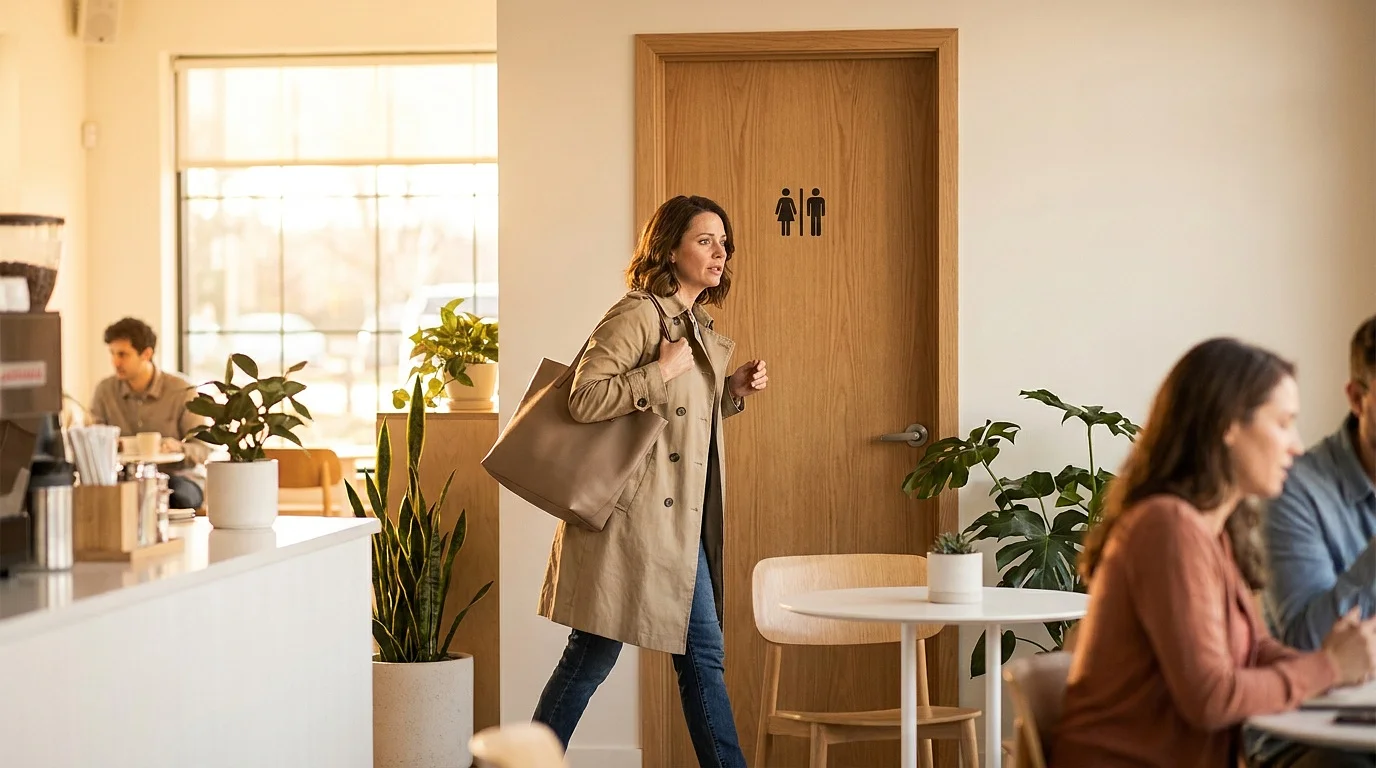
You know exactly where every bathroom is. The one at your favorite coffee shop, the gas station halfway through your commute, the far back corner of the grocery store. If you quietly map your day around the nearest restroom, or you get that sudden, can't-wait, key-in-the-door urge the second you pull into the driveway, you are not being dramatic and you are absolutely not alone. What you're describing has a name, it's called overactive bladder, and it happens to be one of the most trainable things I get to work on.
What is an overactive bladder, really?
Overactive bladder, or OAB for short, is a pattern of bladder symptoms driven by urgency: that sudden, strong "I need to go now" signal that feels almost impossible to put off. It usually shows up with a couple of familiar companions:
Going often, frequently more than about eight times in a day
Waking up at night to pee, sometimes more than once
That urgent, can't-wait feeling, with or without a little leaking on the way to the toilet
Here's the part I want you to hear: this is incredibly common. In the United States, somewhere around one in six women deals with these symptoms, and it becomes more likely as we get older, especially around and after menopause. Men can also experience OAB. Sometimes it masquerades as symptoms of prostate issues, however it may occur in up to 15% of men. So if this is you, you're in very good company, even if nobody in your life ever says a word about it.
Wait, isn't this the same as leaking when I sneeze?
Not quite, and the difference really matters, because the fix is different for each one.
Stress leaks happen when pressure from a cough, sneeze, big laugh, or a heavy lift pushes a little urine out. That's more of a support-and-timing issue with the muscles that keep you closed, and it's a slightly different conversation. I walked through that one over in what incontinence treatment actually looks like in pelvic floor PT.
Urge, or overactive bladder, is when your bladder sends up the "go now" alarm too early and too loudly, sometimes when it's barely even half full. That's a signaling and timing problem, not a leaking-under-pressure one.
Plenty of women have a mix of both, which is completely normal and very workable once we actually know what we're dealing with.
So why won't more kegels fix it?
Because an overactive bladder usually isn't a weakness problem, and squeezing harder does not calm a bladder that's already over-signaling.
Here's the part that surprises most people: for a lot of the women I see, the pelvic floor is actually too tight, not too weak. A pelvic floor that never fully lets go can keep the bladder on high alert, so piling on more kegels can quietly make the urgency worse. In my practice, the very first thing I check isn't how hard you can squeeze, it's whether those muscles can fully relax and let go. Kegels do have a real place in this work, just as a quick, in-the-moment tool to settle an urge, not as an all-day squeezing marathon.
What actually calms an overactive bladder?
The genuinely reassuring answer is that the first thing to try isn't a medication, it's retraining, and it works. The national urology guidelines from the AUA and SUFU recommend behavioral therapy as the first-line treatment for everyone with OAB, before any prescription is added. On average, women in these studies see their urgency and leak episodes drop by roughly half, and sometimes as much as eighty percent, with essentially no side effects.
Here's what that retraining actually looks like:
Bladder retraining: gently and gradually stretching out the time between bathroom trips, so your bladder relearns how to comfortably hold a normal amount again
Urge suppression: a simple, learnable skill to ride out a sudden urge instead of dashing for the toilet, and I'll walk you through it next
Pelvic floor work that includes relaxing, not just contracting: so the muscles support you without staying clenched and irritable
A few smart tweaks to what you drink, which we'll get to in a second
How do I stop a sudden urge in its tracks?
This is honestly my favorite thing to teach, because it hands you your power back on day one. When the urge hits, every instinct says rush to the bathroom, but rushing actually feeds the urge and makes it louder. Try this instead:
Stop. Wherever you are, stand or sit still for a moment.
Do a few quick, strong squeezes of your pelvic floor, like little flicks. This sends a reflex signal that tells the bladder to quiet back down.
Take a few slow breaths and let your shoulders drop. Then distract yourself for a beat: count backward from ten, answer a text, anything at all.
Once the urge wave crests and passes, and it will pass, walk calmly to the bathroom. No sprinting required.
The first few times, this feels like a small act of faith. But your nervous system learns quickly, and most people are genuinely surprised at how fast the urges start to lose their grip. I'll coach you through it step by step until it feels automatic.
Do I really have to give up my coffee?
Probably not all of it, so take a breath. Here's what the evidence actually says: cutting back on caffeine genuinely helps a lot of women with urgency and frequency, so swapping that third afternoon coffee for something decaf can make a real difference. But drowning yourself in water doesn't help either, and very concentrated urine can be a little irritating on its own, so the goal is steady, normal hydration rather than extremes in either direction.
And that long list of "bladder irritant" foods you've probably seen online? The research on most of them is honestly pretty mixed. So instead of banning twenty foods and making yourself miserable, I'd much rather help you notice what actually bothers your particular bladder, and keep the rest of what you love.
How do we figure out your pattern?
We usually start with a few days of a simple bladder diary, just jotting down when you go and when the urges hit. It sounds a little tedious, I know, but it tells us so much, and it's often the moment things start to click. One important note first: your doctor will want to rule out a urinary tract infection or anything else, so if your symptoms came on suddenly, or you notice pain, blood in your urine, or a fever, please check in with your provider right away. And if your urgency comes with genuine bladder pain, not just the urge, that can point to something a bit different like interstitial cystitis, which I unpacked in why your bladder hurts when every test comes back normal.
From there, a first pelvic floor PT visit is calmer and more low-key than most people expect. We look at how your pelvic floor actually moves, whether it can both contract and relax, and we build a plan around your real life. If you're curious what that visit is really like, here's what happens at pelvic floor physical therapy.
You don't have to live tied to the nearest bathroom
If you take one thing from all of this, let it be this: an urgent bladder is a learned pattern, and learned patterns can be un-learned. You do not have to organize your whole life around the closest restroom, and you definitely don't have to just quietly live with it. If you're ready to feel in control of your own day again, I would genuinely love to help. You can reach us at (909) 265-3584 or book online, and we'll figure out your bladder's pattern together, right here in Anaheim Hills.
This article is for educational purposes and isn't a substitute for personalized medical advice. If you're experiencing new or worsening urinary symptoms, please consult a qualified healthcare provider.
References